
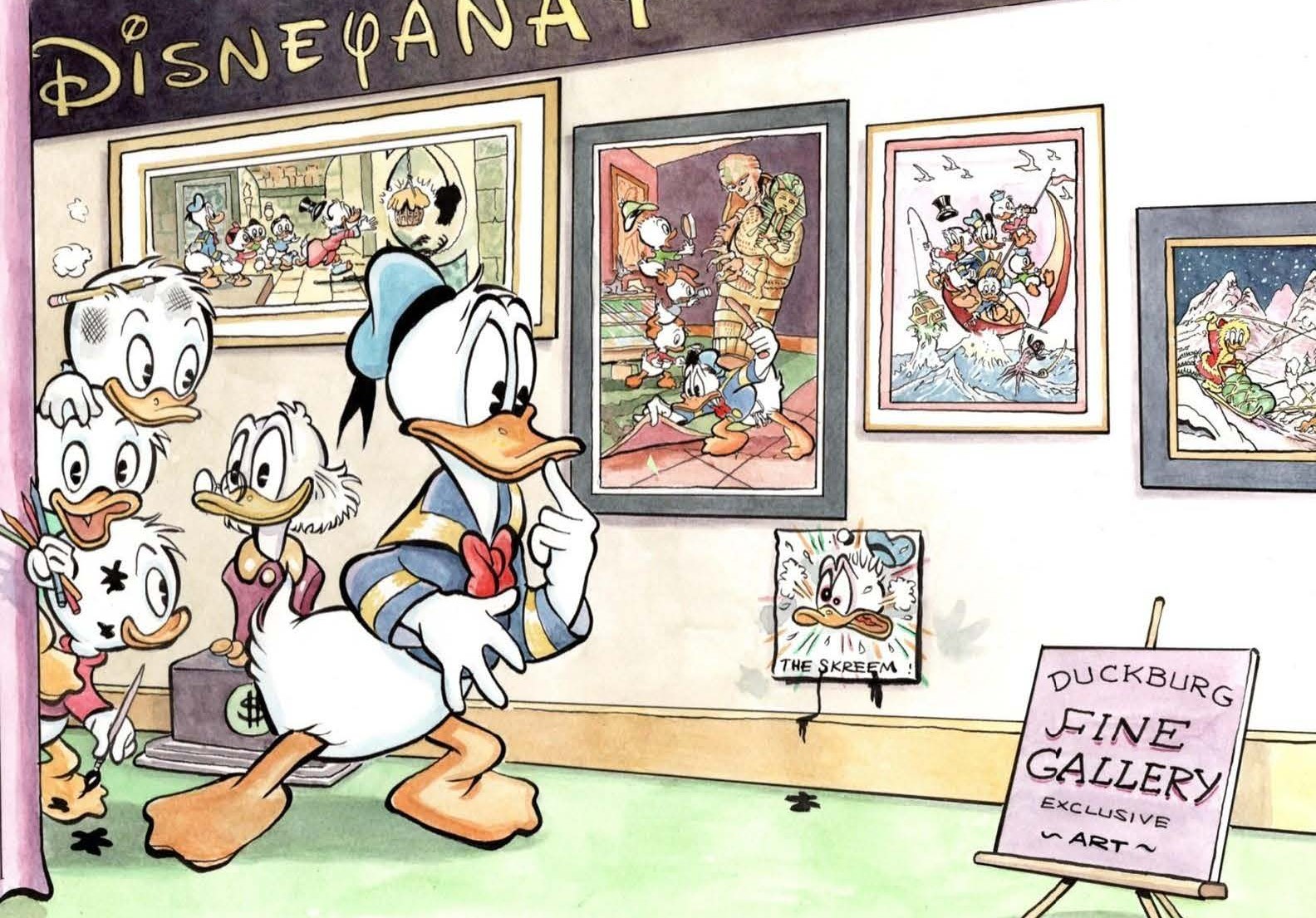
Disney art can be a rewarding field for collectors who want cultural history, emotional appeal and the possibility of long-term value in the same object. But the honest answer to the question “Is Disney art a good investment?” is not a simple yes or no.
The Disney name alone does not make an artwork rare, desirable or likely to appreciate. An original drawing used in the production of a landmark film is fundamentally different from an open-edition decorative print. A signed Carl Barks lithograph from a small, well-documented edition occupies a different market from a mass-produced poster. Even within the same edition, condition, signature, provenance and presentation can create meaningful differences in value.
The best approach is therefore to buy as a collector and assess as an investor: choose art you would be happy to own even if prices stood still, but apply the same discipline you would use for any important acquisition.
The short answer: collect first, invest soundly
Disney art has several characteristics that can support a healthy collectors’ market. Its characters are recognised across generations and countries. The history of Walt Disney Studios is central to the development of animation, while artists such as Carl Barks created stories and characters with cultural lives far beyond their original publications. At the same time, many desirable works are genuinely scarce: a production drawing is unique, an original painting is one of one, and a sold-out signed edition cannot simply be recreated without becoming a different edition.
There is also visible international demand at the upper end of the market. Heritage Auctions reported that its August 2025 Art of Disney auction realised $5.19 million across more than 1,600 lots, with over 4,000 bidders. In July 2026, Carl Barks’ large-format Vacation Panel painting realised $237,500. These results demonstrate serious demand for exceptional material, but they do not mean that every Disney artwork will rise in price. So chose your investments wisely.
What makes Disney art valuable?
1. Authenticity and provenance
Authenticity is the starting point. A collector should be able to establish what the object is, who made or issued it, when it was produced and how it reached the market.
For original animation art, useful evidence can include studio stamps, peg holes, animator notations, scene or sequence numbers, matching imagery from the film and a documented ownership history. For limited editions, check the publisher, edition number, signature, certificate and any accompanying documentation. For original paintings or drawings, provenance linking the work to the artist, studio, publisher or a respected collection can materially strengthen confidence.
A certificate is helpful, but it is not a substitute for knowledge. Its value depends on who issued it and whether the description can be independently reconciled with the artwork. Keep invoices, certificates, correspondence, catalogue pages, photographs of the reverse and records of any restoration together. Good documentation makes a future sale easier and reduces uncertainty for the next collector.
2. Originality and place in the creative process
The word “original” covers several very different things. A one-of-a-kind oil painting is original art. So is an animation drawing used to create a film, although it was produced as one step in a collaborative process. A preliminary sketch, model sheet, storyboard or concept painting may be original and historically important even if it was never intended as a finished display piece.
By contrast, lithographs, serigraphs and giclées are editioned works. They can be highly collectible, especially when they are signed, well produced, scarce and connected to an important artist, but their value logic is different. The more direct the relationship to the creative act, the stronger the object will usually be as a historical artefact.
That does not automatically make every rough production drawing more desirable than every limited edition. Image quality, character, scene, artist, rarity and condition still matter. Originality is a major factor, not the only factor.
3. Historical and cultural significance
Collectors often pay a premium for works connected to firsts, turning points and recognised classics. Early Mickey Mouse, Donald Duck’s formative years, Snow White and the Seven Dwarfs, Pinocchio and other Golden Age productions carry historical weight because they belong to foundational periods in animation.
The same principle applies to comics art. Carl Barks did not merely illustrate familiar characters; he shaped the world of Duckburg and created figures including Scrooge McDuck. A work connected to an important story, character or moment in Barks’ career has a layer of significance that a generic image may not possess.
Historical importance is strongest when it can be explained precisely. “Old Disney art” is not a sufficient description. The film, short, story, scene, date, artist and function of the work should be identified whenever possible.
4. The artist’s importance and collector base
Disney art is not one market. It contains several overlapping collector communities: animation historians, comic-art collectors, Disney enthusiasts, film collectors, fine-art buyers and admirers of individual artists.
An artist with a well-documented career and a lasting collector base generally gives a work more market depth. Carl Barks is the clearest example within Disney Duck art. His authorship, character creation, paintings and carefully produced editions give collectors multiple entry points, from accessible prints to major originals.
Contemporary artists should be assessed somewhat differently. Patrick Block’s close creative connection with Barks, his long career in Disney comics and his original watercolours and paintings give his work a distinct identity. Eric Robison combines a background at Walt Disney Imagineering with a recognisable, expressive visual style and a broad range of originals and limited editions. In both cases, collectors should distinguish between unique works, small signed editions and more widely available pieces.
Names alone are never enough. Ask what role the artist played, whether the artwork is typical of the qualities collectors value in that artist, and whether there is a broad or developing audience for the work.
5. Character, scene and visual appeal
Two works of the same age and type can sell very differently because one contains a more desirable image. A clearly recognisable character, a strong pose, an emotionally resonant moment or a composition featuring several central characters can attract more bidders than a minor transitional image.
For animation drawings, a full-figure image with expressive features will often be easier to display and understand than a partial or indistinct in-between drawing. For Carl Barks art, classic Money Bin scenes, strong Scrooge imagery and compositions involving the Duck family have obvious narrative appeal. For contemporary art, the strength of the composition and the artist’s individual style matter at least as much as the popularity of the character.
This is one area where personal taste and marketability often align: the image that makes you stop and look is likely to have the same effect on other collectors.
6. Genuine scarcity
Scarcity must be examined, not assumed. An edition of 100 may sound small, but the complete edition structure can include artist’s proofs, printer’s proofs, international editions, remarques or later versions. Conversely, a larger edition by a major artist can remain desirable if the motif is iconic and most examples are held in established collections.
For original production art, uniqueness does not always equal rarity in a commercial sense. Thousands of drawings may have been created for a film, but far fewer may survive from a particular scene, character or early production. The meaningful question is not simply “Is this unique?” but “How often does comparable material appear?”
Sold-out status can support demand, but it should never be the sole reason to buy. A scarce object without collector interest remains difficult to sell.
7. Condition, conservation and framing
Paper, paint, ink and animation cels are vulnerable materials. Fading, foxing, toning, moisture, adhesive staining, trimming, tears and poor restoration can reduce both aesthetic and market value. Nitrate and acetate cels have their own conservation risks, while signatures and hand-applied details should be examined carefully.
Good framing protects rather than merely decorates. Use conservation-quality, acid-free materials and glazing that reduces ultraviolet exposure. Avoid direct sunlight, high humidity, heat sources and rapid environmental changes. Do not dry-mount valuable works, trim original paper or attach certificates permanently to the art.
Original frames can sometimes form part of an edition’s identity, particularly where a publisher created a distinctive licensed presentation. In such cases, replacing the frame may affect completeness even if the artwork itself is unchanged. Preserve labels, plaques and backing information before any reframing.
8. Comparable sales and market depth
Asking prices are not the same as achieved prices. Before making a substantial purchase, look for actual auction results, dealer sales, archived listings and recent offers for genuinely comparable works.
Comparison requires care. A signed lithograph should not be valued from the auction price of the original painting on which it was based. A production drawing with a central character cannot be compared directly with a minor in-between drawing from the same short. Edition, size, condition, signature, provenance, framing and buyer’s premium all affect the result.
One exceptional auction price does not establish a new value for every related work. Repeated sales across time and more than one venue provide stronger evidence.
9. Total acquisition cost and resale horizon
The price on the label is only part of the investment calculation. Shipping, insurance, customs duties, VAT, auction buyer’s premiums, professional framing, conservation and future selling fees can all affect the break-even point.
Disney art is normally better suited to patient collectors than short-term traders. A longer horizon gives a work time to become scarcer in the open market and allows the collector to wait for the right buyer rather than accept the first offer. Even then, appreciation is never guaranteed.
Which types of Disney art have the strongest collector logic?
Original Disney animation art
Original Disney animation art offers a direct physical connection to the production process. A drawing, cel, storyboard or model sheet may have played a real role in bringing a character to the screen. That gives it an authenticity and historical immediacy that later reproductions cannot duplicate.
The strongest examples tend to combine several factors: a recognised film or short, an important character, an appealing image, clear production evidence, good condition and reliable provenance. Early material can be especially scarce, including original Donald Duck animation art from 1934, but age alone does not determine value.
Collectors should also understand the object they are buying. A production drawing, concept drawing, layout, storyboard and model sheet served different purposes. Accurate identification is part of the value.
Carl Barks art and editions
Carl Barks art and collectibles form one of the most established areas of Disney collecting. Barks’ importance rests on authorship as well as imagery: his stories helped define Donald Duck’s world, and he created Scrooge McDuck and many other enduring Duckburg characters.
His market includes unique paintings and preliminary drawings, signed lithographs and serigraphs, bronzes, porcelain figures, books and other documented editions. These should not be treated as interchangeable. Original paintings occupy the top end of the market, while signed limited editions can offer a more accessible route into a mature international collecting field.
For lithographs, study the publisher, year, edition size, proof designation, signature, condition and original presentation. Another Rainbow editions, for example, have their own histories and edition structures. A collector who understands those differences is better placed to recognise an unusual version or avoid overpaying for an incomplete one.
Original art by Disney-connected artists
Unique drawings and paintings by artists with a meaningful place in Disney history can offer compelling collector value. Works by Tom Wood, Hank Porter and Manuel Gonzales connect to early studio publicity, character development, comics and the visual culture surrounding Disney’s Golden Age.
This area rewards research. Attribution, publication history, intended use and provenance can be more important than decorative finish. A preliminary study that can be matched to a published image may carry greater historical interest than a more polished but poorly documented work.
Contemporary Disney fine art
Contemporary artists can provide the most accessible meeting point between collecting and living with the art. Patrick Block continues the tradition of narrative Disney Duck art through originals, watercolours, paintings and editions. Eric Robison offers a distinctly modern, energetic interpretation of familiar characters through original paintings, studies, lithographs and giclées.
For long-term value, prioritise work that is recognisably the artist’s own rather than merely a competent rendering of a famous character. Unique originals, important subjects, strong examples of the artist’s style and genuinely small signed editions generally have a clearer scarcity story.
The secondary market for a living artist can be less mature than that of an established historical figure. That can create opportunity, but also greater uncertainty. Buy the strongest work you can afford and make enjoyment the first return on the purchase.
Limited-edition lithographs, serigraphs and giclées
Editioned art is not automatically “less serious” than original art. A well-produced, hand-signed, low-edition print by a significant artist can have a committed collector base and may be far more attainable than the original painting.
The key is selectivity. Check the total edition, all proof categories, whether the edition is sold out, the printing method, paper or canvas, publisher, signatures, certificates and condition. A numbered print from an edition that remains widely available at retail is unlikely to behave like a genuinely scarce, long-sold-out work.
Fine art giclées of classic Disney art can be an excellent way to collect compelling imagery at an accessible price. They should primarily be bought for artistic and decorative enjoyment unless the edition, artist, provenance and market demand provide a persuasive collector case.
A practical hierarchy of long-term potential
There are exceptions at every level, but collectors can use the following hierarchy as a starting point:
- Historically important unique works: major concept paintings, exceptional production art, published originals and significant paintings by leading artists.
- Strong original works with clear provenance: attractive production drawings, model sheets, storyboards, preliminary art and original contemporary paintings.
- Signed, scarce editions by established artists: particularly iconic motifs, low editions, recognised publishers and complete original presentation.
- Well-documented specialist collectibles: bronzes, porcelain, glass and other editions with genuine scarcity and an active collector base.
- Decorative or open-edition art: ideal for enjoyment and display, but usually weaker as a financial proposition because supply is not meaningfully restricted.
This is not a price list. A superb signed edition may be more desirable than a weak original, and a modest production drawing can carry remarkable historical interest. Quality within the category matters.
How to buy Disney art with long-term value in mind
Before buying, work through this checklist:
- Identify the object precisely. Is it an original, a production-used work, a limited edition, a proof or an open edition?
- Verify authenticity. Examine the signature, publisher, studio indicators, certificate and provenance as relevant.
- Understand the artist and context. Know why the artist, film, story, scene or edition matters.
- Assess the image. Choose strong, recognisable and visually satisfying examples.
- Check scarcity properly. Look beyond the stated edition number and investigate proofs, variants and comparable availability.
- Inspect condition. Ask about fading, trimming, repairs, foxing, adhesion, cel deterioration and restoration.
- Compare achieved prices. Use genuinely comparable sales and remember fees.
- Calculate the full cost. Include delivery, tax, framing, insurance and eventual selling costs.
- Plan to hold patiently. Do not depend on a quick resale.
- Buy something you genuinely want to own. Enjoyment is the only return available from day one.
Red flags to avoid
Be cautious when a seller relies on phrases such as “rare”, “investment piece” or “museum quality” without supplying verifiable detail. Other warning signs include unclear edition structures, missing or generic certificates, signatures that cannot be explained, vague descriptions of “original” art, undisclosed restoration, poor framing, prices based only on current listings and pressure to buy before documentation can be reviewed.
The most trustworthy sellers are willing to explain exactly what an object is and what it is not.
Frequently asked questions
Is Disney art a good investment?
Yes, Disney art has demonstrated strong collector demand and long-term price growth, particularly historically important original art, leading artists and scarce signed editions.
What Disney art is most valuable?
The highest prices are generally achieved by exceptional original works: concept paintings, important production art, rare cels with significant backgrounds, published original illustrations and major paintings by artists such as Carl Barks. Within every category, subject, provenance, condition and historical importance can dramatically affect value.
Are Disney lithographs worth collecting?
Yes. Signed and numbered Disney lithographs by important artists can be highly collectible, especially when the edition is small, sold out, well documented and in excellent condition. They should be evaluated as editioned works, not valued by reference to the unique original painting.
Is original Disney animation art valuable?
It can be. Original animation art is unique production material and therefore has an inherent historical connection to the film or short. Value depends on the production, character, scene, image quality, type of artwork, condition and provenance. Not every production drawing is equally scarce or desirable.
How can I tell whether Disney art is authentic?
Start with a precise description and documentation. Depending on the object, look for studio indicators, production notations, publisher information, edition numbers, signatures, certificates, invoices and provenance. Compare these details with known examples and consult a specialist when the value or attribution justifies it.
Does professional framing increase the value?
Good conservation framing primarily protects value rather than creating it. Acid-free materials, appropriate mounting and UV-reducing glazing can slow deterioration. An expensive decorative frame will not compensate for a weak or damaged artwork, while poor mounting can permanently reduce value.
Which Disney characters are best for collectors?
Iconic characters such as Mickey Mouse, Donald Duck and Scrooge McDuck often have broad demand, but character alone is not enough. The artist, period, scene, medium, rarity and visual quality determine whether a particular work is compelling.
How long should I hold Disney art?
There is no fixed period, but collectible art is generally better suited to a long horizon. Buying and selling costs are significant, and finding the right buyer can take time. Collectors should not purchase with money they may need at short notice.
Final thoughts
Disney art sits at an unusual intersection of fine art, popular culture, animation history and personal memory. That combination can create durable demand, but only informed selection separates a meaningful collectible from an attractive souvenir.
The strongest purchases usually share the same qualities: clear authenticity, convincing provenance, genuine scarcity, an important artist or production, a desirable image, sound condition and a price supported by comparable material. Apply those standards consistently, and the collection will have substance whether the market rises, pauses or changes direction.
Explore Gallery Disneyana+’s curated selections of Carl Barks art, original Disney animation art, Patrick Block and Eric Robison, or contact us for guidance on a particular work, edition or collecting direction.